 Colocation is usually seen as a long-term model: a company installs its servers in a data center and uses the rented space for several years. However, an additional rack or part of a rack may also be needed for a limited period, to test new infrastructure, support a temporary project, or handle a predictable increase in workload.
In such situations, adding permanent capacity is not always practical. Temporary infrastructure provides the required rack space, power, and connectivity for the period when they are actually needed, while allowing the company to continue using its own hardware.
However, short-term colocation and rack server rental have their own considerations. In addition to the cost of rack space, companies need to account for site preparation, hardware installation, cross-connects, network configuration, Remote Hands, and subsequent decommissioning. The economics should therefore be evaluated for the entire project rather than based solely on the monthly rack price.
When Infrastructure Is Needed Temporarily
The need for additional physical space does not always mean permanent growth of the IT infrastructure. Temporary infrastructure rental usually makes sense in three situations.
Testing new infrastructure. A company may need a physical environment to test servers, storage, network equipment, or a new architecture before deploying it in production.
Seasonal workload growth. Additional compute resources may be required during a specific period — for example, during an annual sales peak, a major campaign, or another predictable increase in workload.
Temporary project. Infrastructure is deployed for a task with a known or approximately known duration. This may be a separate customer project, a temporary corporate system, processing a large dataset, interim infrastructure during technical changes, or another task after which the additional capacity is no longer required.
In all these cases, it is important to determine not only the number of servers required but also how long they will be used. If the additional workload becomes permanent, a long-term hosting model may be more cost-effective.
Test Infrastructure Outside Production
Testing an individual application can be done on a virtual machine, but this is not always sufficient when testing server architecture.
A company may need real hardware to test a storage cluster, network topology, multiple servers, or a fault-tolerant configuration. An office lab environment may not fully reproduce data center conditions in terms of power, connectivity, and equipment deployment.
Temporary rack space makes it possible to assemble the system in an environment close to future production and test:
- server configuration;
- storage and data operations;
- network topology;
- failover and redundancy;
- performance under load;
- interaction between multiple physical components.
Once testing is complete, the equipment can be moved to permanent infrastructure, used for another project, or decommissioned. This scenario is particularly relevant when the goal is to test the physical infrastructure architecture as a whole rather than an individual software component.
Seasonal Peaks: When Adding Hardware Makes Sense
Seasonal workload growth does not always require physical infrastructure expansion.
If a workload can be moved quickly to virtual resources, Cloud makes it possible to add and remove capacity without installing new servers. For a short or poorly predictable peak, this is often easier than deploying additional hardware.
However, some workloads run on specialized equipment, require substantial local storage, physical isolation, or a specific server configuration. In these cases, temporarily increasing rack capacity can be a practical option.
A company can install additional servers in advance of an expected peak, use them during the period of increased demand, and then decommission them or move them to another project.
With this approach, deployment time needs to be taken into account. Physical infrastructure cannot be expanded as quickly as the number of cloud instances: servers need to be delivered, installed, connected, and tested.
Temporary colocation is therefore better suited to predictable and sufficiently long workload peaks that can be prepared for in advance.
 1U, Part of a Rack, or a Full Rack
Temporary infrastructure does not necessarily mean renting an entire server rack.
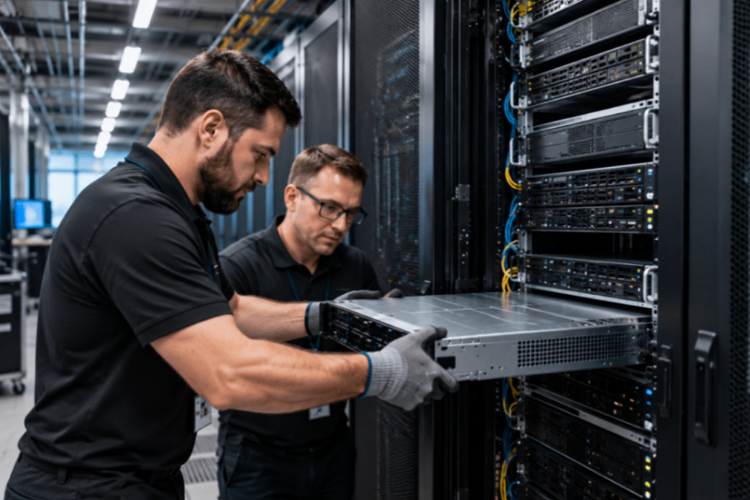
For a few servers, individual rack units may be sufficient. If more servers, storage, and network devices are required, a ¼ or ½ Rack can be used. A Full Rack is suitable for a larger standalone configuration.
The choice depends on more than the physical number of devices. Power consumption, the number of network connections, cabling infrastructure, and the potential for further expansion should also be considered.
For example, several GPU servers may occupy relatively little rack space while requiring high power density. Calculating requirements based only on the number of rack units can therefore give a misleading picture of the resources needed.
What Temporary Infrastructure Includes Beyond Rack Space
Available space in a rack alone is not enough to run equipment. A temporary deployment requires a complete set of resources to be defined:
- the required number of rack units or rack size;
- available power capacity;
- A/B power feeds and redundancy requirements;
- network bandwidth;
- IP addresses and routing;
- required cross-connects;
- data center access for technical staff;
- Remote or Smart Hands;
- physical security requirements.
If multiple racks or external systems are involved, connections between the components should be planned in advance.
Temporary infrastructure should therefore be viewed as a complete environment for operating hardware for a limited period, rather than simply as the rental of available rack space.
Connectivity Can Determine Deployment Time
For temporary infrastructure, it is particularly important to consider not only the availability of rack space but also the time required to provision network connectivity.
If the project only requires a standard Internet connection, deployment may be relatively straightforward. However, requirements for private connectivity, connections to another site, a telecom carrier, or a cloud platform may require additional cross-connects.
These tasks can sometimes become a critical part of the deployment schedule. The rack and power may already be available while the required network connection is still being provisioned.
Before ordering temporary colocation, it is therefore necessary to determine:
- required bandwidth;
- number of physical connections;
- redundancy requirements;
- whether private connectivity is required;
- lead times for provisioning cross-connects;
- whether existing IP addresses need to be retained or new addressing configured.
For a project lasting only a few months, a network provisioning delay of several weeks can significantly change the economics of the entire solution.
Remote Hands Simplify Operations at a Temporary Site
A short-term project does not always justify having an in-house engineer regularly present at the data center.
Some physical operations can be delegated to Remote or Smart Hands. On-site technicians can follow agreed procedures to install equipment, check cable connections and indicators, perform a power cycle, connect devices, or replace components.
This is particularly useful when the equipment is located in another city or country.
Remote Hands does not, however, replace system administration. The company can continue to manage the operating system, applications, network, and data itself while delegating only the necessary physical tasks to data center personnel.
When budgeting for a temporary project, the cost of these services should be included in advance, particularly if several stages of equipment installation and decommissioning are expected.
Short-Term Rental Is Not Always Cheaper Than Long-Term Colocation
A short period of use does not automatically mean a low total cost.
Temporary infrastructure has a relatively high proportion of one-time expenses. In addition to the monthly rack space fee, there may be costs for setup, equipment delivery and installation, cross-connects, network configuration, Remote Hands, and subsequent decommissioning.
The total project cost can be represented approximately as:
Temporary infrastructure cost = setup + rack space + power + connectivity + cross-connects + support + logistics + decommissioning.
The shorter the project, the greater the impact of one-time expenses on the effective monthly operating cost.
Short-term colocation therefore makes sense not because the monthly rate is necessarily lower, but because the company gains access to physical infrastructure without having to retain excess capacity after the project is completed.
The minimum contract term should also be checked in advance. Short-term colocation conditions depend on the provider, available capacity, and the specific configuration.
When a Dedicated Server Is Better Than Rack Space
If a company needs compute resources but does not specifically need to use its own equipment, it is worth comparing colocation with renting a Dedicated Server.
A Dedicated Server is already installed in the data center and connected to the provider’s infrastructure. This eliminates the need to deliver the company’s own hardware and reduces the number of physical operations required when starting and ending the project.
This option is particularly convenient for temporary workloads that can run on a standard server configuration or one already available from the provider.
Colocation, by contrast, has an advantage when specific company-owned hardware must be used: specialized servers, storage appliances, network equipment, GPU systems, or preassembled infrastructure.
The choice is therefore determined by more than the duration of the project. The key question is whether the company needs temporary physical space for its own equipment or simply temporary compute capacity.
 When Cloud Is the Better Option
For short-term and rapidly changing workloads, Cloud generally provides greater elasticity.
Cloud resources can be deployed without shipping equipment and shut down immediately after the task is completed. This makes them convenient for short compute jobs, development, software testing, and poorly predictable workload peaks.
Physical infrastructure becomes more relevant when a workload depends on specific hardware, requires substantial local storage, a particular network topology, or physical isolation.
Workload duration also matters. Deploying company-owned servers for only a few days of additional capacity is usually impractical. If a project lasts several months and the company already owns the hardware, the economics may look very different.
Cloud and temporary colocation therefore address different requirements: Cloud primarily provides rapidly scalable virtual resources, while temporary colocation provides a short-term facility for operating physical equipment.
Temporary Infrastructure Should Match the Duration of the Project
Short-term colocation allows companies to use their own hardware without building permanent additional infrastructure. This model is suitable for test environments, predictable seasonal peaks, and projects with a limited duration.
However, temporary colocation should not be evaluated solely by the cost per rack unit or rack. Power, connectivity, cross-connects, logistics, physical work, and the time required for deployment all affect the project.
If only compute capacity is required, Cloud or Dedicated Servers may be more practical. If specific physical equipment needs to be hosted temporarily, rack space allows the company to retain control over its hardware while using the infrastructure of a professional data center.
The optimal option is therefore determined by a combination of three factors: what equipment is required, how predictable the workload is, and how long the infrastructure will be used.